
Insights · Healthcare fit-out · Clean rooms
ISO 14644 clean room classes, in plain language
What ISO Class 5, 7 and 8 measure, how a room is tested against them, and what to check before you accept one.
The short answer
In short
ISO 14644-1 sorts a clean room by how many airborne particles a counter finds in one cubic metre of air. For particles of 0.5 micrometres and larger, ISO Class 5 allows 3,520, Class 7 allows 352,000 and Class 8 allows 3,520,000. The class is a test result, so you accept a room on its report, not on its drawings.
- Standard
- ISO 14644-1:2015, confirmed in 2021
- Compared at
- Particles of 0.5 micrometres and larger, per cubic metre of air
- Classes KRM builds
- ISO Class 5 to ISO Class 8
- Proof
- Particle counts, pressures and HEPA integrity in a certified report
What the class number counts
A particle counter draws a measured volume of air through a beam of light and counts the flashes. ISO 14644-1 turns those counts into a class between ISO Class 1 and ISO Class 9, and the class tells you how clean the air was while the test ran. Each step up in the class number allows ten times as many particles as the step before.
The standard sets limits at several particle sizes between 0.1 and 5 micrometres. The table below uses 0.5 micrometres, the size the old Federal Standard 209E classes were based on, for ISO Class 5 to 8, the range we build in healthcare work. The counts are cumulative, so the 0.5 micrometre column includes every particle of that size or larger. The standard's scope is set out on the ISO website.
| Class (older name) | 0.5 micrometres and larger | 1 micrometre and larger |
|---|---|---|
| ISO Class 5 (Class 100) | 3,520 | 832 |
| ISO Class 6 (Class 1,000) | 35,200 | 8,320 |
| ISO Class 7 (Class 10,000) | 352,000 | 83,200 |
| ISO Class 8 (Class 100,000) | 3,520,000 | 832,000 |
Federal Standard 209E was replaced in 2001, yet its class names still turn up on drawings and in specifications, so you need to read both systems.
The class describes a result, not a design
ISO 14644-1 stops at particle counts. It does not say how many air changes an hour a room needs, what pressure it should hold against the corridor, or which finishes to use, and because it covers particle concentration only, it says nothing about bacteria or other living contamination. Those answers come from the project brief and from the references the consultant designs to. On clinical work that usually means ASHRAE 170 and HTM 03-01 for ventilation, and USP <797> and <800> for pharmacy clean rooms. Our glossary explains each of them.
So the class of each room is settled before anyone builds anything. It comes from the client's brief, the consultant's specification and the requirements of the licensing authority, which in Abu Dhabi is the DoH. A good set of tender drawings states it room by room.
At rest or operational: which state does the class apply to?
ISO 14644-1 defines three occupancy states, and ISO 14644-3 sets out the tests that are run in them. As built means the room is finished and its services are running, but there is no equipment and nobody inside. At rest means the equipment is installed and running as agreed, still with nobody inside. Operational means the room is working normally with the agreed number of people in it. There is a short ANSI summary of ISO 14644-3 if you want the outline of the tests.
A room can pass at rest and fail in operation, because people shed particles. Gowned staff, opening doors and trolleys moving in and out all push the count up. The contract therefore needs to say which state the class applies to, and the handover test needs to be run in that state. Some specifications give a class for each state, with a looser limit for the operational one.
How we test a room before handover
The order matters. We start with the filters, because a leaking HEPA seal cannot be fixed by anything done later. Each terminal HEPA filter is scanned for leaks with a test aerosol (DOP or PAO), the installed filter leakage test that ISO 14644-3 describes. Then we measure airflow and air changes, read the pressure difference between rooms with the doors closed, and only then count particles. The count comes last because it means little until the first three are right.
The results go into a certified report with the particle counts, the pressure readings and the filter integrity results. Re-validation can be placed under an annual maintenance contract, which is worth considering because a room holds its class only while its filters, fans and housekeeping keep doing their job.
HEPA grades are often confused with room classes, so a word on them. Under the US definition, a HEPA filter removes at least 99.97% of particles of 0.3 micrometres. Under the European standard EN 1822, an H13 filter has an overall efficiency of at least 99.95% and an H14 filter at least 99.995%, both measured at the most penetrating particle size. A good filter helps, but it does not give you a class. The class is whatever the counter reads in the finished room.
What goes wrong on site
In the 20-plus pharmacy clean rooms we have delivered in the UAE, a failed first count has nearly always traced back to the building, not the filters. Gaps around ceiling panels and service penetrations let uncontrolled air into the room. Doors that do not close fully, or that open the wrong way, upset the pressure between rooms. Ducts that were not cleaned or capped during construction blow dust into the room the first time the air-handling unit runs. And a room where the finishing trades are still working will not reach its class while the fans are on, because every trade adds to the count.
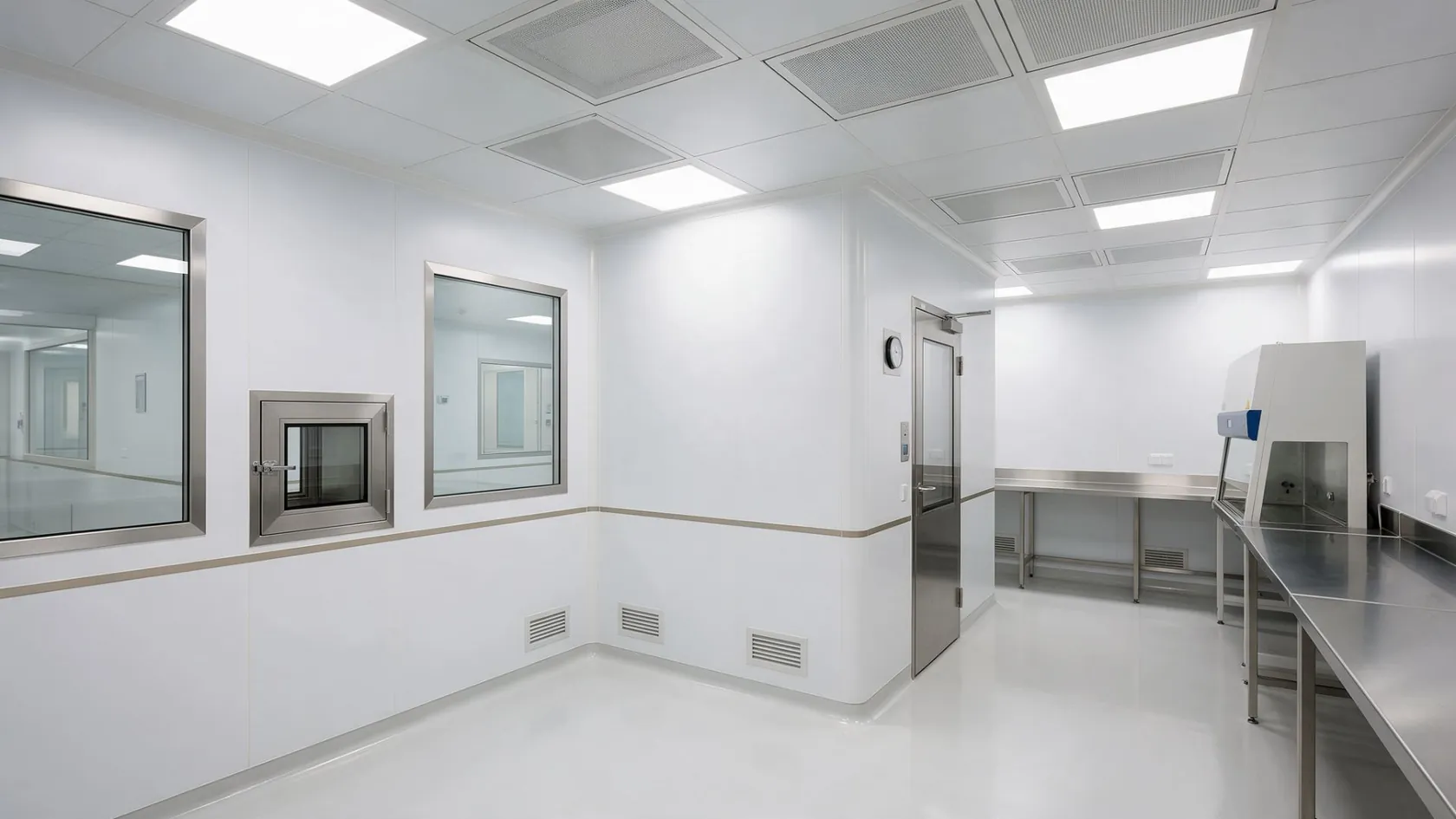
The cure is a sequence: seal the envelope, clean the ducts, then run the air-handling units and test. It also helps to build the room from modular wall and ceiling panels, flush doors and coved flooring, which leave no ledges or square corners for dust to settle in.
What to ask for before you accept a room
Before you sign the handover, the file should contain:
- The class of each room, with the state it applies to: as built, at rest or operational.
- The HEPA leak-test result for every terminal filter, with each filter identified.
- Airflow, air-change and room-pressure readings taken with all doors closed.
- The particle-count report: sampling locations, particle sizes counted, the date, and the calibration certificate of the counter.
- A plan for re-testing.
Our clean-room page lists what we build and how a room is delivered. Operating theatres, where HEPA filtration and pressure control matter just as much, are on the operating theatres page, and the services behind both are covered under MEP engineering and maintenance and AMC.
Questions answered
Frequently asked questions
What is the difference between ISO Class 7 and ISO Class 8?
Ten times the particle limit. At 0.5 micrometres and larger, ISO Class 7 allows 352,000 particles per cubic metre and ISO Class 8 allows 3,520,000. Under the older Federal Standard 209E they were called Class 10,000 and Class 100,000.
Does a HEPA filter make a room ISO Class 5?
No. The filter is one part of the system. The room also needs a sealed envelope, the right airflow and pressure, and trained staff in suitable gowns. The class is confirmed only by the particle count in the finished room, in the agreed state.
Does ISO 14644-1 set air changes per hour or room pressures?
No. It classifies air cleanliness by particle concentration only. Air changes and pressure differences come from the project brief and the guidance the consultant uses, such as ASHRAE 170 and HTM 03-01 for clinical ventilation.
Who decides which ISO class a room needs?
The client's brief and the consultant's specification, within the requirements of the licensing authority and the standard the facility works to, for example USP <797> for a sterile compounding pharmacy. We build to the class shown on the approved drawings.
Request a proposal
Have a facility to build, fit out or maintain?
Send us the drawings, a scope or just an idea. The CEO and the department head review every enquiry personally and reply within one working day with a clear proposal, programme and price.
Last updated